
Webster County Criminal Court Cases
Webster Circuit Court hears capital offenses and felonies after indictment or information. Webster District Court handles misdemeanors, violations, traffic matters, arraignments, and probable-cause proceedings for felony allegations. Both sit at 35 U.S. Highway 41A South in Dixon. The Office of Circuit Court Clerk keeps both sets of local case records, yet each court has its own records line: 270-639-9160 for Circuit and 270-639-9300 for District.
The Kentucky Circuit Court jurisdiction page explains the felony-level role that controls Webster County criminal court cases.
That statewide jurisdiction rule places the post-indictment felony file with Webster Circuit Court rather than the jail or arresting agency.
Webster Circuit Records
35 U.S. Highway 41A South
Dixon, KY 42409
270-639-9160
Monday-Friday, 8 a.m.-4 p.m.
Webster District Records
Same Judicial Center
Dixon, KY 42409
270-639-9300
Monday-Friday, 8 a.m.-4 p.m.
Two Webster County Criminal Case Numbers
A felony incident can create two official court cases. District Court opens the preliminary matter for arraignment, bond, and probable cause. If the grand jury indicts, Circuit Court opens a new felony case with its own number. The Administrative Office of the Courts warns that statewide criminal-case statistics can count the incident once at each level. A name search limited to one jurisdiction may therefore look complete while missing half the procedural history. Webster's calendar makes the transition visible. District Court meets Tuesday at 9 a.m. Grand Jury meets the second Wednesday at 8 a.m. Circuit Court and Circuit arraignments sit at 9 a.m. on the first and third Thursdays. Those are record-creation points. They are not promised processing deadlines.
The Kentucky District Court jurisdiction page confirms the misdemeanor and felony-preliminary work done at the lower level.
Search both Webster court levels whenever an alleged felony moved beyond its first hearing.
Note: A second court number may mark the felony's move to Circuit Court, not a second alleged incident.
Searching Webster County Case Records
Start with free KYeCourts guest case information. The entry screen requires reCAPTCHA and a Continue action. Research could not inspect fields beyond that gate, so no unsupported online field list is supplied. Treat the result as a locator. For the actual Webster County case record, call or visit the clerk and provide a case number when possible.
- Open KYeCourts guest access and pass its reCAPTCHA gate.
- Search the available public case information using the most exact identifier the system accepts.
- Check District and Circuit jurisdictions when the allegation was a felony.
- Read the docket status and note the complete case number, filing year, court level, and charge.
- Contact the Webster clerk for the underlying docket, order, judgment, recording, transcript, or certified copy.
At the clerk counter, the best identifier is the complete case number. A full name, approximate filing year, and court level can help staff distinguish similar records. Ask which added data the clerk needs. Do not send unnecessary Social Security numbers.
| Field | Type | Required | Notes |
|---|---|---|---|
| Case number | Text | Best, not always required | Verify the exact Kentucky court number. |
| Party name | Spoken or written | Clerk determines | Common names may need another identifier. |
| Approximate filing year | Year | No | Helps separate active and archived cases. |
| Court level | District or Circuit | Recommended | Felony matters may exist in both. |
Webster County Court Clerk Files
The Administrative Office of the Courts does not keep the county's trial-court case file. A request sent to central AOC without first identifying the Webster record can fail. The local clerk can say whether a case remains in Dixon, has moved to a records facility, or has been destroyed under an approved retention schedule. If a file is archived, get both the case number and file-locator number before contacting the State Records Center. That center cannot search by a person's name or Social Security number. For a local copy request, specify the exact item needed, such as the docket sheet, charging document, final judgment, sentencing order, or a particular motion. Video and transcripts should be requested by proceeding and date, and their availability depends on whether they were created and remain public.
The official Kentucky legal-forms catalog helps identify statewide court forms by number and subject.
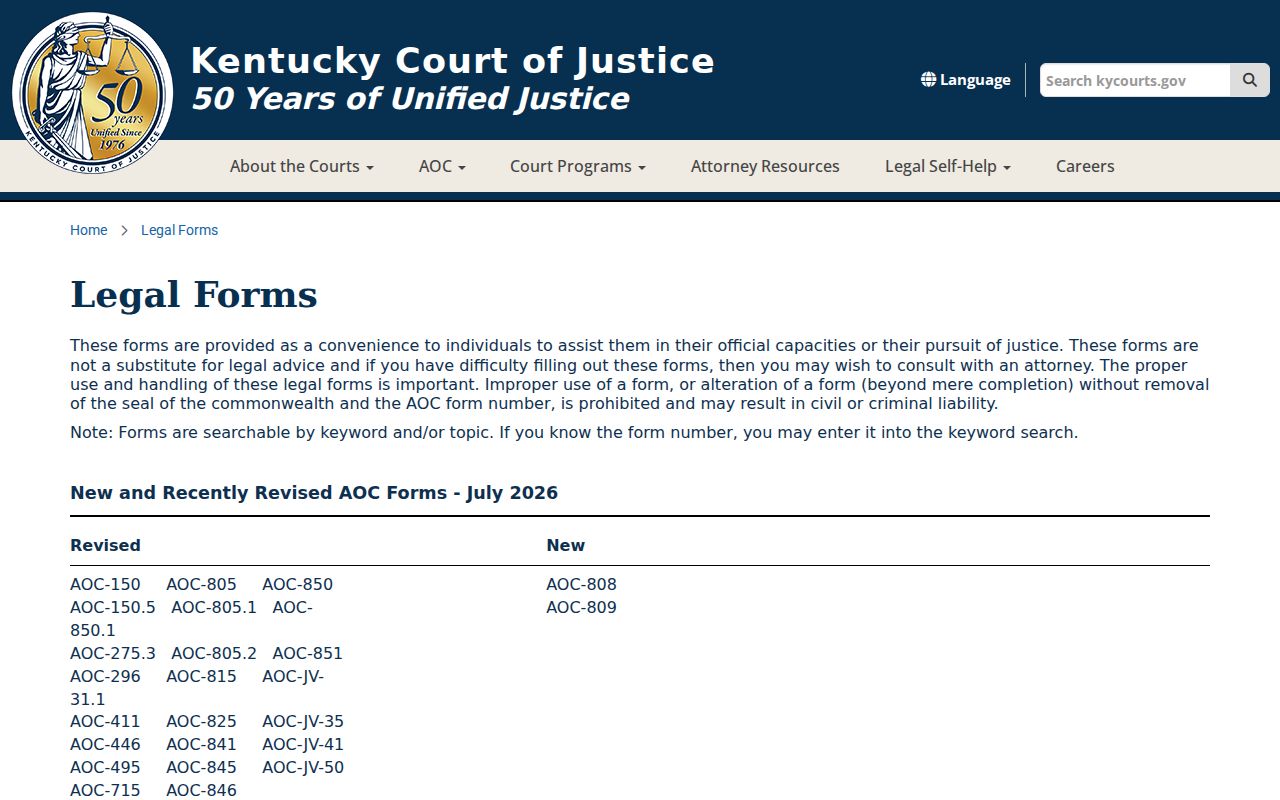
The form library supports a request or filing, but it does not replace the Webster clerk's case-file index.
Note: The Webster court page publishes no copy price, so confirm page count, certification, delivery method, and current fee first.
Inside a Webster County Case File
A Webster County criminal case file identifies the jurisdiction, case number, filing date, status, judge, Commonwealth, defendant, and counsel when entered. Its charging record may include a citation, complaint, indictment, information, charge description, and Kentucky statute. The docket then traces hearings and filed documents. The final order should be read charge by charge because one count may be dismissed while another results in conviction.
| Case Number & Court | Jurisdiction, Webster County, filing year, case type, sequence, status, and assigned judge. |
|---|---|
| Charging Document | Citation or complaint in District Court, and indictment or information when a felony reaches Circuit Court. |
| Docket Entries | Chronological filings, motions, orders, hearings, continuances, plea, trial, judgment, and appeal activity. |
| Hearing Dates | Arraignment, probable-cause hearing, pretrial events, plea, trial, sentencing, and revocation dates as applicable. |
| Disposition & Judgment | Dismissal, acquittal, plea, verdict, conviction, or other result for each filed count. |
| Sentence & Conditions | Confinement, probation, fines, costs, restitution, and conditions written into the judgment. |
A court file is not the same as a KSP criminal-history product. The KSP result depends on agency and disposition reporting across Kentucky. The Webster file preserves the litigation of one prosecution and may contain documents that never appear in a repository summary.
Reading Webster County Criminal Case Outcomes
Several docket terms mark different steps, not the same result. An indictment is a grand jury's formal accusation and is not a conviction. A no true bill means the grand jury did not indict. Disposition means the outcome of a charge. Nolle prosequi records the prosecutor's formal decision not to continue a charge. A plea is the defendant's formal response, while a judgment records the court's final action.
- Arraignment
- The hearing where charges and rights are addressed and a plea may be taken.
- Probable cause
- The early District Court inquiry into whether a felony allegation should proceed.
- No true bill
- A grand jury decision not to return an indictment.
- Disposition
- The final result of a charge or case.
- Sentence
- The consequence ordered after a conviction.
The arrest charge is only the allegation recorded at custody. Prosecutors may amend, dismiss, or replace it. Search the Webster County judgment and disposition rather than treating the initial booking label as the final court charge.
Note: Read each count separately because dismissal of one charge does not establish the outcome of another count.
How a Criminal Case Moves
A misdemeanor generally remains in Webster District Court from filing through disposition. A felony usually begins there for arraignment and probable-cause work, then moves to Webster Circuit Court after an indictment or information. Motions, plea talks, trial preparation, and hearings create docket entries along the way. If a conviction follows, the judgment and sentencing order become the chief outcome records.
Case flow: Charges Filed › Arraignment › Pretrial › Plea or Trial › Disposition › Sentencing
Not every case uses every stage. Dismissal may end a prosecution early. A plea can avoid trial. An appeal creates a separate appellate record. The Kentucky Court of Appeals and Supreme Court use state appellate-clerk channels and C-Track public access, not the Webster trial-court counter alone.
Federal Criminal Cases Outside Webster County
Webster County lies in the Western District of Kentucky, but federal prosecutions do not become Webster Circuit Court files. They are searched through PACER and the federal district court. A federal docket may show the case number, parties, judge, indictment or information, filings, hearings, judgment, and sentence. Sealed filings remain unavailable. The official PACER service requires registration and applies the federal usage-fee schedule, with qualifying low quarterly use waived under current policy.
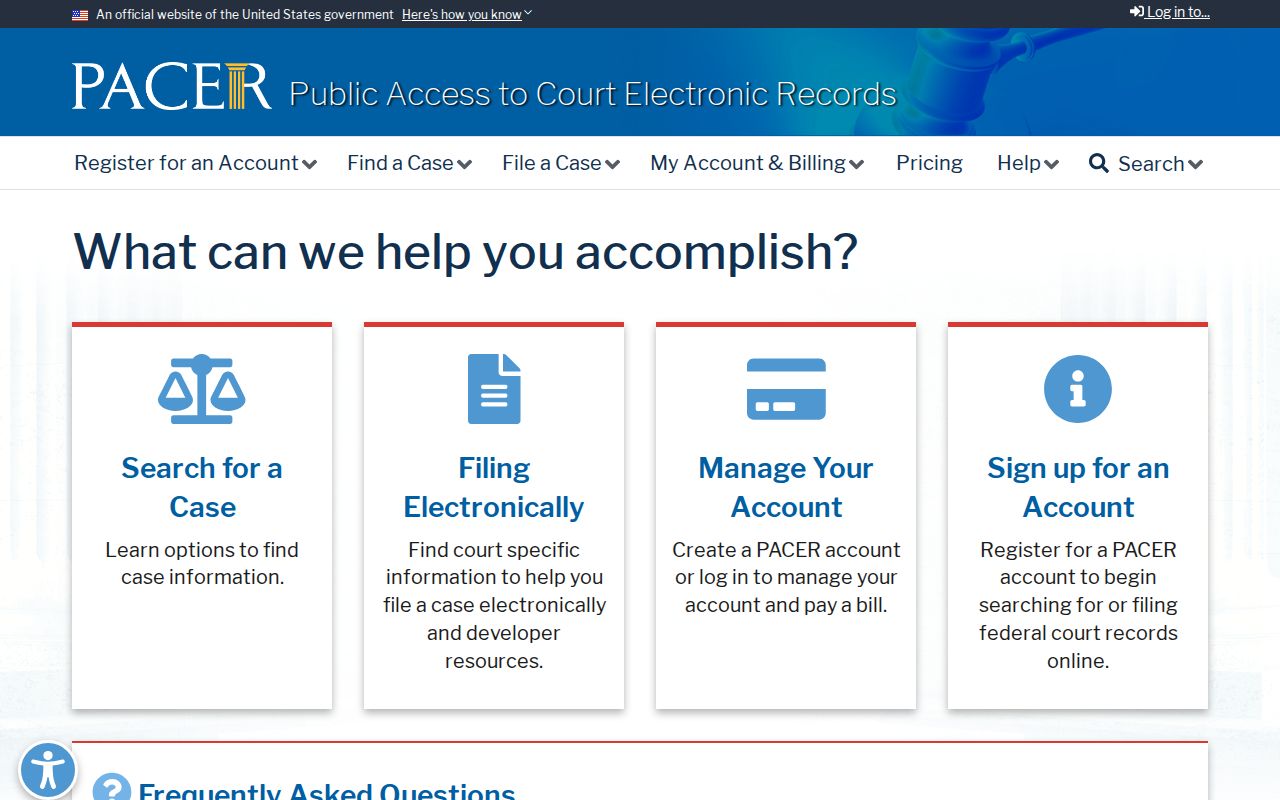
PACER is the federal case-file channel; it is not a search for Webster County District or Circuit dockets.
The Western District of Kentucky court site supplies local federal court information and notices.
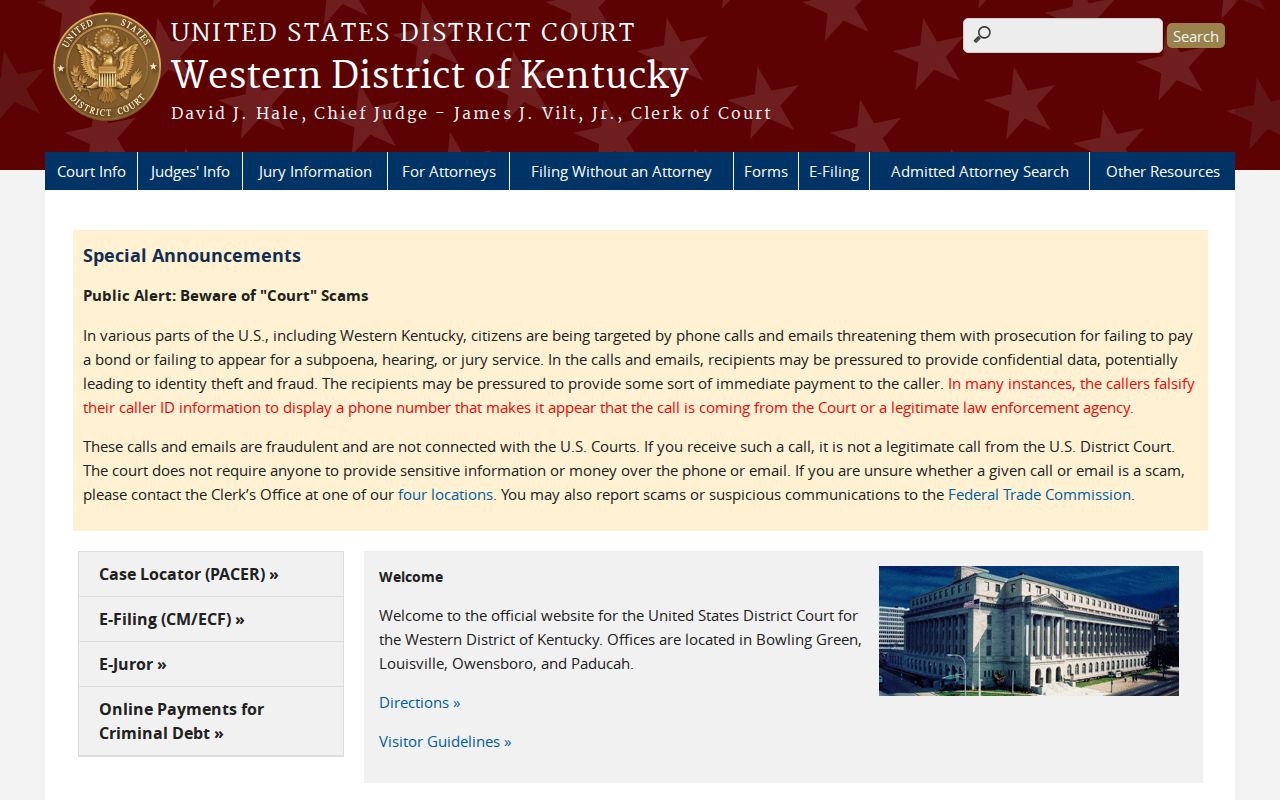
The district court source completes the federal path without confusing it with Kentucky's county trial-court system.
Case Record Access & Restrictions
Kentucky's open-records rules do not make every item in a Webster County criminal case public. Protected identifiers, juvenile information, victim or minor data, expunged or sealed material, and nonpublic grand-jury content can be withheld or redacted. Evidence, reports, recordings, and transcripts are document-specific. Their existence in a file does not erase another law's protection.
When a case does not appear online, ask the Webster clerk whether it is indexed under a different court level, archived, restricted, expunged, or no longer retained. State why the record is being sought and name the exact document, but do not press staff for legal advice. If access is denied, request the governing rule or exemption in writing.
Access distinction: The Kentucky Open Records Act can reach public records held by their custodians, while KRS 17.150 keeps centralized criminal-history records outside general public inspection. A clerk case file and a KSP history are separate products.
Webster County Court Bond Payments
The official Webster court page lists cash, check, money order, and credit or debit card payments, with a fee for card use. It separately states that cash is required for bond. Eligible court balances may be payable through ePay, but that service should not be confused with posting a bond at the counter or paying for record copies.
Before traveling, call the clerk for the exact transaction. Ask whether the balance is eligible for ePay, which court holds it, what identifier is needed, and whether a card fee applies. For copies, ask the page count and certification price because no Webster copy fee is published.
Note: Payment status is part of the court's financial record, but it does not replace the judgment or disposition.